
CENTRION / Machine learning & decision systems
UDI Kernel
A Rust decision runtime with Python training tools, local ONNX inference, confidence thresholds, and configurable decision policies.
- Rust
- Python
- ONNX Runtime
What is UDI Kernel?
A local decision runtime built in Rust with Python training tools. UDI Kernel turns typed task definitions and JSON inputs into structured decisions, scores, and rankings through ONNX Runtime. Confidence thresholds, out-of-distribution signals, fallback decisions, and configurable policies connect model predictions to application behavior.
For developers building applications that need structured model decisions, classification, or ranking with explicit rules for uncertain predictions.
A closer look
Scroll to read ·Select an image to view full size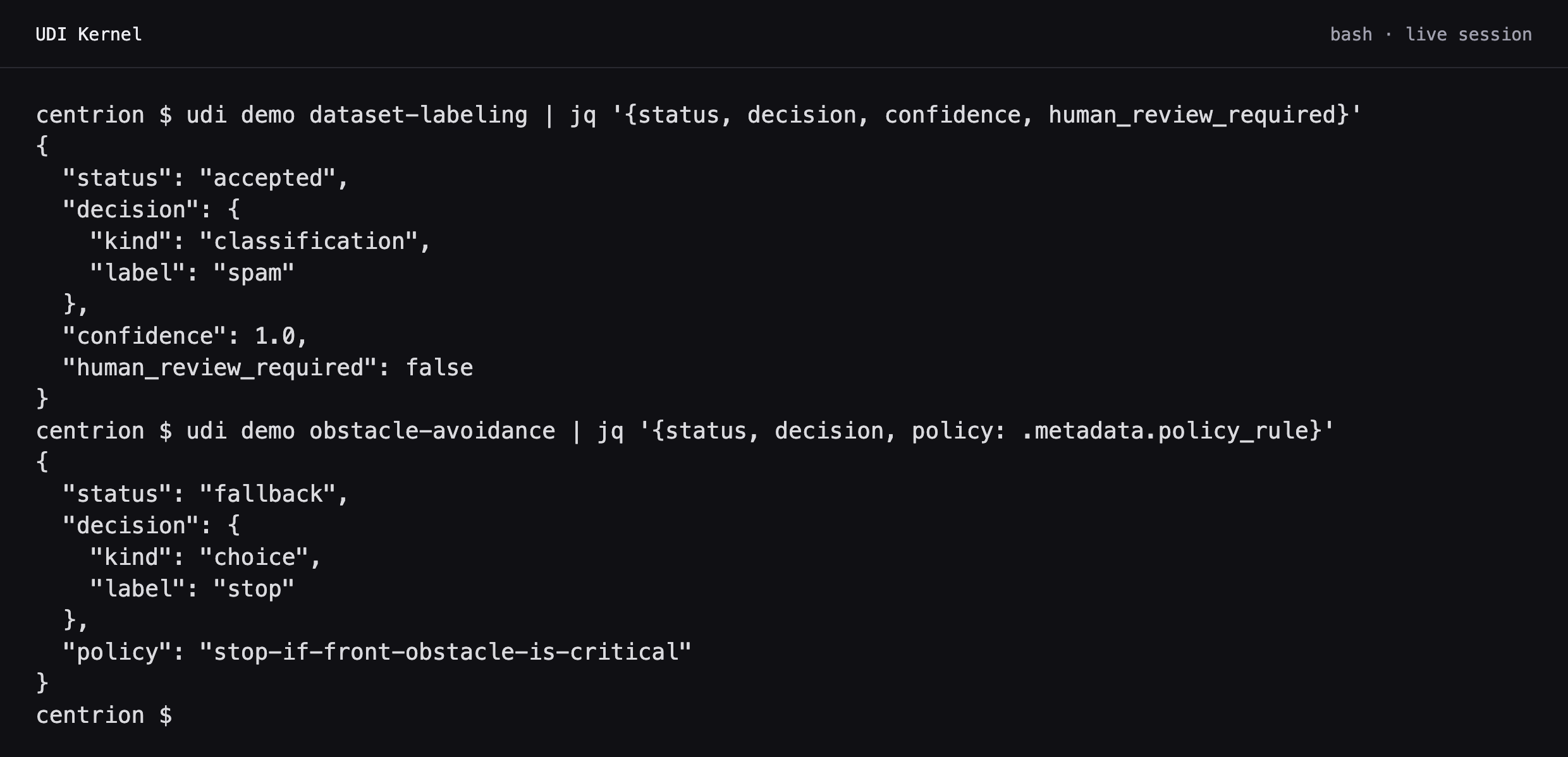
Inside UDI Kernel
Local model inference
ONNX Runtime runs model inference locally. Typed task definitions and JSON inputs connect the model to application-specific decisions, scores, and rankings.
Confidence and decision policies
Confidence thresholds and out-of-distribution signals can trigger fallback decisions or abstention. Configurable rules can override a model result or request human review.
Training and evaluation tools
Python training tools produce model bundles and evaluation reports. Example tasks explore text labeling, option ranking, and obstacle-avoidance decisions.
How it works
- Define the task, expected inputs, decision type, thresholds, and policies in YAML.
- Prepare a model bundle with the Python training tools and run local inference through ONNX Runtime.
- Use the structured decision, confidence, and policy outcome in the application through the Rust API or command-line interface.
Project status
UDI Kernel is in development. Included examples use synthetic datasets to demonstrate the training and decision pipeline; model quality needs evaluation on the data of each intended application. For availability, documentation, or collaboration, contact Centrion.